

Here’s something nobody told you when you set up your online Counselling Directory website or Psychology Today profile: being qualified isn’t enough to get someone to click. Neither is being warm, understanding, or genuinely brilliant at your job.
When someone is scrolling through a directory full of therapists — where every single profile is warm, qualified, and professional-sounding — good isn’t going to cut it. You need to sound clear enough, specific enough, and human enough that the right person stops scrolling and thinks: this one might be for me.
That’s a much harder thing to achieve when you’re staring at a blank text box trying to summarise your entire practice in a few hundred words. So it’s not surprising that most therapists follow the same thinking pattern: I’ll focus on demonstrating my professionalism. I’ll show people I genuinely care. I’ll cover all bases so I attract more clients.
That’s exactly the problem.
What’s Actually Happening When Someone Reads Your Profile
They’re not reading. They’re scanning.
When a potential client lands on your directory page, they’re usually mid-scroll, comparing you with ten other therapists, and making fast decisions about whether to keep reading or move on. In those first few seconds, they’re asking themselves:
- Does this person help people like me?
- Do they get what I’m actually going through?
- Does something about this feel different from the last five profiles I just skimmed?
- Do I feel okay enough to click?
Most profiles fail that test — not because they’re badly written, but because they’re written to sound credible rather than to make someone feel seen.
The Gap Between How You Think Your Therapist Directory Profile Reads and How It Actually Lands
There’s often a gap between how you think your profile comes across and how potential clients actually experience it. You use the language you think clients want to hear, without realising your profile sounds the same as every other therapist’s.
The problem isn’t your ability or expertise. It’s messaging. And that’s fixable.
Here’s what most therapist profiles accidentally signal, versus what they should be communicating:
| What Your Profile Says | How Clients Experience It |
|---|---|
| Warm and professional | Generic “been-there, read-that” |
| Covers all bases | Speaks to nobody specifically |
| Lots of qualifications | Hard to connect with |
The Biggest Mistakes on Online Counselling Directory Profiles
Look at Counselling Directory and Psychology Today and you’ll notice one thing instantly: every therapist listed is highly qualified. Well, duh. But that’s exactly the point — people using these platforms already expect qualified professionals. That expectation is where things get interesting, because it means qualifications alone don’t differentiate you. Something else has to.
Mistake 1: Stating the Obvious
You have limited space to convince a potential client to click through and learn more. Use it to state the obvious, and you’ve already faded into the background.
Generic reassurance is the biggest culprit.
Four words show up again and again: safe, confidential, non-judgemental, space. Put them together and you get the all-time classic — “I offer a safe, no-judgement space” or “Confidential, no-judgement space.” Nearly every profile on the page says some version of this, which means it says nothing at all.
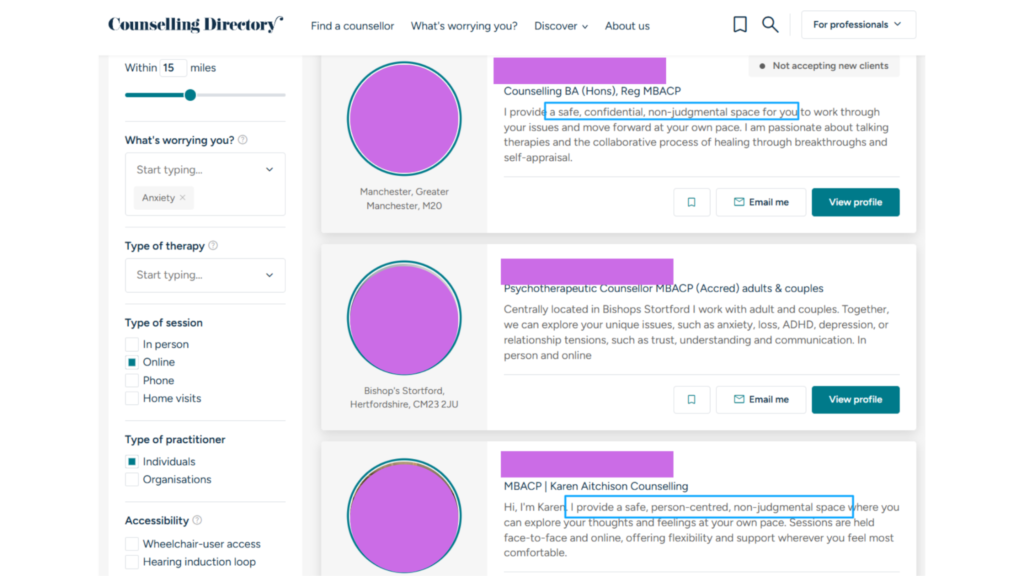
Leading with biography is the second version of the same mistake.
Potential clients already assume you care — you didn’t spend years training to be careless. So when your profile opens with your background, your qualifications, or your passion for helping, you’re using valuable space to confirm something they already believed walking in.
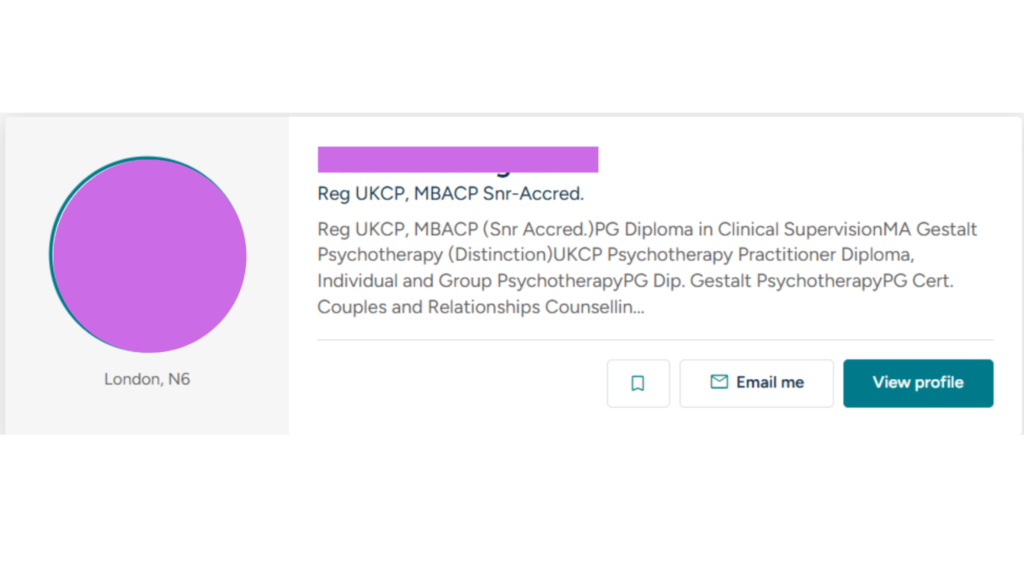
Qualification overwhelm compounds it further.
You’re a therapist, you’re highly qualified — people already know that. Bombarding them with a wall of letters and training titles is off-putting, not because qualifications don’t matter, but because it centres the profile on you instead of on them.
Mistake 2: The People-Pleasing Trap
As a therapist, you want to come across as approachable and understanding. But when you try to talk to everyone, you’re effectively reaching nobody on a deep level.
People don’t choose a therapist because they sound nice. They choose a therapist because they feel understood — and can see the potential impact of working with them.
Speaking to everyone is the trap.
Niching down is something every therapist eventually has to consider, and I’m not here to tell you that you must do it — but I do recommend focusing on a few core services rather than positioning yourself as a therapist for everyone. When you’re a jack or jane of all trades, the person searching for something specific won’t feel confident you can help them.
Being approachable instead of transformational is the subtler version.
Think about the last time you bought a product or invested in a service. Did you choose it because it sounded nice and might help? Or because you could see the potential impact on your life? The most effective profiles let potential clients imagine what life looks like after working with you — not just that you seem like a pleasant person to talk to.
Mistake 3: Wasting Valuable Space
On directory sites, people see a small snippet before they ever click through, and that snippet decides everything.
Wasting the first two lines is the most common way this goes wrong.
The opening lines carry most of the weight because people are scrolling fast. If they say something bland like “I offer a safe, confidential space,” you’ve missed your one chance to grab attention with specificity or emotional resonance.
Choosing the wrong photo matters more than most therapists realise.
On a crowded results page, people are judged heavily on their headshot before they read a word. Dark photos, selfies, and a lack of eye contact are the three biggest errors — your photo should be warm, direct, and clearly show your face.
Before You Write a Single Word on Your Online Counselling Directory Profile
Most therapists sit down to rewrite their profile and start typing immediately. That’s the first mistake. It’s what leads to vague, generic profiles that don’t connect with anyone in particular.
Before touching your actual profile text, it’s worth running a quick diagnostic — it takes about ten minutes, and it’s the difference between a profile that could belong to anyone and one that sounds unmistakably like you, written for exactly the right person.
The Identity Echo

Here’s something worth sitting with: you think your online counselling directory profile comes across as warm, specific, and reassuring. But if you’re using the same phrases as every other therapist on the directory — safe space, non-judgemental, passionate about helping — the person reading it may experience something completely different.
That gap between how you think your profile reads and how a potential client actually experiences it is what I call the Identity Echo. It shows up like this:
- You think you sound warm → they experience generic
- You think you sound thorough → they experience overwhelming
- You think you sound professional → they experience hard to connect with
- You think you’re speaking to everyone → they feel spoken to by no one
The Identity Echo isn’t a reflection of your ability. It’s a messaging problem — and it’s one you can actually test for.
The exercise is simple: answer a short set of questions based on how you think your profile currently reads. Then hand your actual profile to someone who doesn’t know your work — a friend, a partner, a trusted peer — and have them answer the same questions cold.
Where your answers match, that’s what’s working. Where they diverge, that’s your Identity Echo, and it’s exactly what the rest of this process is built to fix.
Download The Identity Echo Worksheet
The Five Questions to Answer Before You Write Your Online Counselling Directory Profile
Don’t skip this part. Your answers here are the foundation for everything that follows, and the actual writing becomes significantly easier once you’ve done the thinking. You’re not drafting profile copy yet — just getting clear in your own head.
1. Who is this profile written for? Be specific. Not “adults struggling with mental health,” but the actual person you most want to reach. Example: adults in their 30s and 40s who appear to hold everything together on the outside but feel exhausted, anxious, and disconnected underneath.
2. What are they actually dealing with right now? Write it in their language, not yours — forget clinical terms. What does life actually feel like for them? Example: they can’t switch their brain off. They lie awake going over conversations. They feel like they should be coping better than they are.
3. What do they want instead? What does the life they’re hoping for actually look like? Example: to feel calm. To stop second-guessing every decision. To feel like themselves again.
4. What does working with you actually feel like? Not your modality, not your approach in clinical language — what does a client actually experience in session? Instead of “I use an integrative approach drawing on CBT and person-centred principles,” try “a space to slow down, say the things you’ve never said out loud, and start making sense of what’s going on.”
5. What makes your work distinct? No need to be dramatic. Think about the clients you work best with, the issues you come back to most, how people tend to describe working with you, and the kind of change you help people make.
Your Profile Has Two Jobs
Here’s something most profile advice gets wrong: it focuses on one part of your directory presence and ignores the other. Your profile actually has two completely different jobs.
The snippet is the 2–3 lines visible in search results before anyone clicks. It sits alongside every other therapist in your area, and it has exactly one job — make the right person curious enough to click.
The full profile is what someone finds once they do click. It’s where connection deepens and the decision to reach out actually gets made. Its one job is to make the right person feel understood enough to enquire.
Most therapists write their full profile and hope the first two lines double up as a snippet. That’s like writing a book and hoping the first paragraph works as the cover blurb. They’re different pieces of writing, and they need to be treated that way — which is exactly why each of the three formulas below gives you both.
Three Formulas, Three Kinds of Practice
Read through all three before picking one. Each suits a different type of practice.
- You work across a range of issues and aren’t ready to niche → Formula 1
- You know who you help but don’t have a formal specialism → Formula 2
- You have a clear specialism or defined area of focus → Formula 3
Formula 1: The Clear & Credible Profile
This works best if you work across different presenting issues and aren’t ready to niche down. You work with anxiety, depression, stress, relationships, low mood, life transitions — and you don’t have to narrow that. But trying to list everything you offer turns what should be a compelling profile into a long list instead of a message. This formula moves the focus away from what you treat and onto who finds you most helpful.
The Snippet Formula: [relatable emotional experience] + [what your profile offers them]
Before: “I am an integrative therapist offering a safe, confidential, non-judgemental space for individuals experiencing a wide range of emotional difficulties.”
After: “I work with adults who feel stuck, overwhelmed, or like they’re repeating the same cycles without knowing why. Therapy with me is a space to slow down, make sense of what’s going on, and start finding steadier ground.”
The full profile formula:
- Expand on the snippet — go deeper into what life feels like for them right now
- Reflect what they may have tried, or what coping has looked like
- Explain what working with you actually involves, no jargon
- Show what becomes possible
- Close with brief, human credentials
After: “I work with adults who feel stuck, overwhelmed, or like they’re repeating the same cycles without really knowing why. Maybe you’ve been managing on your own for a long time. Pushing through, telling yourself it’s not that bad, waiting for things to settle. But underneath, something feels heavy — and that’s exhausting in a way that’s hard to explain to anyone else. Therapy with me is a space to slow things down. To figure out what’s actually going on beneath the surface and start finding ways of responding to life that feel less draining and more like you. We’ll work at your pace. There’s no pressure to have everything figured out before you get in touch — most people don’t. You just need to feel ready to start. I’m a BACP-registered therapist specialising in supporting adults through anxiety, low mood, stress, and life transitions. I aim to make therapy accessible, and offer both online and in-person sessions.”
Why it works: waiting for things to settle names a specific pattern that makes the right person feel seen. Hard to explain to anyone else validates the isolation without dramatising it. We’ll work at your pace addresses the fear of commitment that stops many people reaching out in the first place. And the credentials land after connection has already been made — not before it.
Formula 2: The Pain Point & Result Profile
This is best if you have a clear sense of who you help and the outcomes of therapy, even without a formal specialism. You still know your people. The formula is built on two principles: show someone you understand what life feels like for them, then show them the transformation.
Unlike Formula 1, you’re not painting a broad emotional experience — you’re writing for a specific person you know well.
The snippet formula: [specific experience or pattern] + [what shifts through working with you]
Before: “I am passionate about supporting clients on their healing journey using an integrative, person-centred approach in a warm and supportive environment.”
After: “You’ve been stuck in the same patterns for a while. Overthinking, second-guessing yourself, never quite feeling like you’re doing enough. I help you understand what’s driving it and start responding to life with more clarity and self-trust.”
The full profile formula:
- Open with the specific experience — expand on the snippet
- Go deeper into what that actually feels like day to day
- Name the paradox — the thing they can see happening but can’t stop
- Pivot to what changes through working with you
- Brief, specific credentials
After: “Feeling stuck in the same patterns? Overthinking everything, second-guessing yourself, never quite feeling like you’re doing enough? It’s exhausting — especially when you can see it happening but don’t know what’s causing it. You know the anxiety is disproportionate. You know the way you talk to yourself isn’t kind. But making it stop seems completely out of your control. And so you keep going. You hold it together on the outside, manage what needs managing, and wait for a moment that feels calm enough to actually deal with it. That moment rarely comes. That’s where I come in. Together we’ll get underneath the patterns — not just what’s happening on the surface, but what’s actually driving it. So you can start responding to life differently. With more clarity, more self-trust, and a lot less noise in your head. I’m an integrative therapist working with adults experiencing anxiety, burnout, and self-doubt, online and in person across the UK. I’m registered with the BACP.”
Why it works: knowing that doesn’t make it stop names the meta-experience rather than just the symptoms. That moment rarely comes lands hard because it’s true, and they know it. A lot less noise in your head describes the result in their language, not clinical language. And “that’s where I come in” pivots confidently without ever tipping into salesy.
Formula 3: The Specialist Profile
If you have a clear specialism — eating disorders, OCD, neurodivergence, relationship difficulties — this is the one. It establishes you as an expert and attracts the right clients, and it works precisely because it doesn’t try to appeal to everyone. Specialist profiles tend to perform better on directories because they align with what people are actually searching for.
The snippet formula: [who you work with + what they’re dealing with] + [what becomes possible]
Before: “I specialise in trauma and offer EMDR therapy in a safe and supportive environment for individuals who have experienced difficult life events.”
After: “I work with women who have experienced trauma and are tired of feeling like they’re living in survival mode. Through EMDR and trauma-informed therapy, I can help you process what happened, so it stops defining how you feel every day.”
The full profile formula:
- Name exactly who you work with and what they’re carrying
- Go deep into the specific felt experience
- Acknowledge what they may have been told or tried
- Introduce hope — briefly and honestly, no overpromising
- Explain your specialist approach in plain English
- Close with specific credentials and relevant training
After: “I work with women who have experienced trauma and are tired of feeling like they’re living in survival mode. Whether you live in a constant state of hypervigilance, or are always waiting for something to go wrong, you’re probably wondering if you’ll ever feel different. It can. I won’t promise it’s quick or easy. But I will tell you that what you’re experiencing makes complete sense given what you’ve been through. With the right support, it doesn’t have to stay this way. Through EMDR and trauma-informed therapy, we’ll work at your pace to process what happened, so it stops living in your body, stops hijacking your days, and stops defining how you see yourself. I’m a BACP-accredited therapist specialising in trauma, PTSD, and complex trauma, with advanced EMDR training. I work with women online and in person.”
Why it works: always waiting for something to go wrong describes hypervigilance in plain language, no clinical jargon required. Two words on their own line — “It can.” — deliver hope without overpromising anything. Stop living in your body captures the somatic experience of trauma without ever using the word “somatic.” And again, credentials land last, once the person already feels understood.
Now It’s Time to Write Yours
You’ve seen the formulas and seen them applied. Here’s the process:
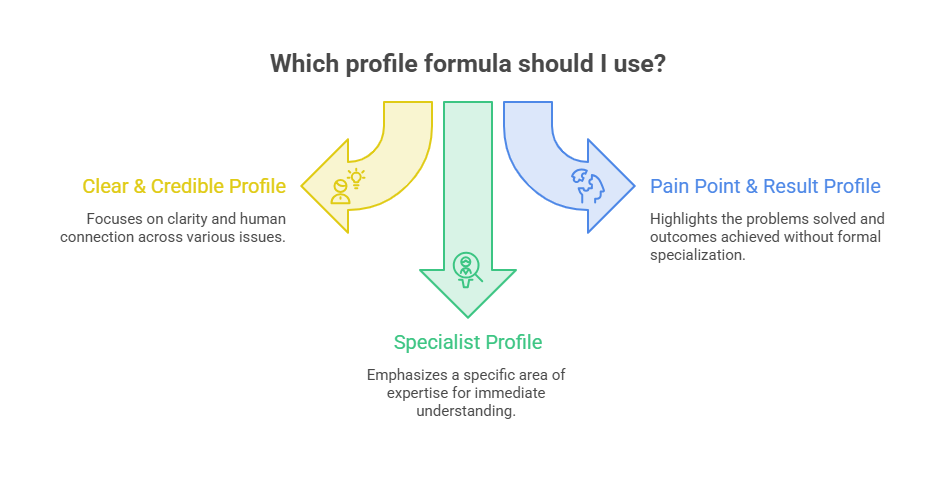
Step 1 — Choose your formula. Formula 1 if you work across a range of issues and want to sound clearer and more human. Formula 2 if you know who you help and what tends to shift, even without a formal specialism. Formula 3 if you have a clear specialism and want the right person to feel immediately understood.
Step 2 — Write your snippet. Keep it to 2–3 sentences, following your chosen structure. Make the right person recognise themselves.
Step 3 — Write your full profile. Aim for 150–250 words. Follow the formula. Don’t worry about polish yet — this is a rough draft, not a final version.
Step 4 — Run it through this checklist before you publish:
- Does it make the right person stop within the first line?
- Does it speak to a specific experience rather than a general one?
- Is it free from generic phrases like “safe space” and “non-judgemental”?
- Does it give someone a reason to click through?
- Is it 2–3 sentences maximum?
Full profile:
- Does it expand on the snippet rather than repeat it?
- Does it reflect what your ideal client is actually experiencing, in their language?
- Is there a moment where the right person would think, yes, that’s exactly it?
- Does it show what becomes possible through working with you?
- Does it sound like a human wrote it, not a therapist writing for other therapists?
- Do credentials come at the end, after connection has been made?
- Is it 150–250 words?
- Would you enquire, if you were the person it’s written for?
But What Should I Do if….
I don’t have a niche and I’m not sure who my profile is for?
Go back to question one and spend more time there. Think about the clients you’ve most enjoyed working with — not the ones you felt you should work with, but the ones where the work felt meaningful and the progress felt real. That’s usually where the answer is hiding. You don’t need a niche to have a compelling profile — Formula 1 is built for exactly this.
My directory has a word count limit?
Focus your effort on the snippet and the first paragraph of your full profile — these two sections do most of the work regardless of length.
I’m newly qualified and don’t have much experience to reference?
You don’t need years of experience to write a strong profile. You need clarity about who you help and what you offer. Formula 1 or Formula 2 both work without requiring case history or long-term clinical experience — keep your credentials simple: qualification, membership body, and whether you work online or in person.
One Final Thing
A stronger profile won’t fix every marketing problem, but it will solve the most common one: looking qualified while failing to come across as the right solution for the people who need you.
Your potential clients will also use your profile to find their way to your website, so every signal should point in the same direction — who you help, how you work, and why you’re the right choice.
Get that right, and clients find you. Not because you’ve changed what you do, but because you’ve finally found the right words for it.
If you’d like someone to look over your profile, my consulting services are here to help. Or, if you want ongoing support, take a look at my copywriting services.