
Getting your therapy website online is one thing. Making sure potential clients can actually find it is another.
When someone searches for a therapist on Google, they’re often looking for support with something personal. They want to know whether you offer the right type of therapy, where you’re based, and whether your services are relevant to their needs.
But before they even visit your website, they’ll usually see your meta title and meta description in the search results.
These small pieces of text might not seem particularly important, but they can make a difference to whether someone clicks through to your website or scrolls past it.
The good news? You don’t need to be an SEO expert to improve them.
In this guide, I’ll share some simple website visibility tips for therapists, focusing on how to write clear, relevant meta titles and descriptions that help potential clients understand what you offer. I’ll also include practical examples and AI prompts to make website growth for your therapy business easier.
Why are Meta Titles and Descriptions Important for Therapy Websites?
Meta titles and descriptions aren’t about sounding impressive; they ensure the click makes sense for your target audience. That means your meta title and meta description are often the first version of your message someone sees.
And while they won’t do all the heavy lifting on their own, they do shape the first impression.
They help someone decide:
- Is this relevant?
- Is this what I’m looking for?
- Does this sound useful?
- Is this worth clicking?
That’s why generic titles and descriptions are such a waste.
If the page is specific, but the search result is vague, you’re making the reader work too hard before they’ve even landed on the website.
Good metadata should make the page easier to understand, not harder.
It should help someone quickly work out what the page is about, who it’s for, and why clicking makes sense.
Meta Titles for Therapy Websites
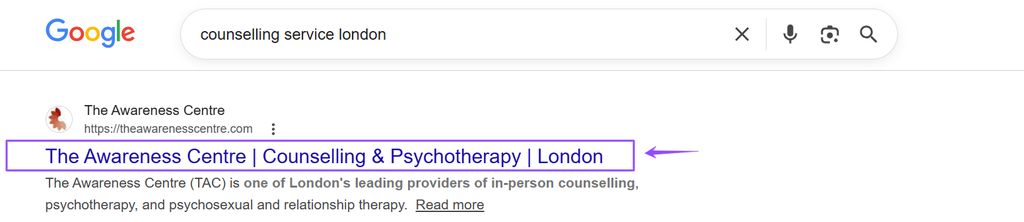
Your meta title is usually the first thing someone notices in the search result.
It needs to make the page topic clear fast.
X Not padded.
X Not vague.
X Not trying too hard.
A strong meta title should help someone understand what the page is about in a glance.
Before someone lands on your homepage or service page, they usually see the search result first.
That means it usually works best when it’s:
- Clear
- Specific
- Relevant to the page
- Written in language a real person would actually search
- Focused on one main topic
Think of it like the headline of the search result.
If the title is weak, unclear, or trying to do too much, the page becomes easier to skip.
What a Good Meta Title Does
A strong meta title usually does four things well.
| 1: It Makes the Page Topic Obvious Someone should be able to tell what the page is about without decoding it.If it’s a homepage, make the business or service area clear. If it’s a service page, name the service properly. |
| 2: It Matches What the Page Actually Covers The title should reflect the page honestly.If the title sounds broader, stronger, or more dramatic than the page itself, it creates the wrong expectation. |
| 3: It Stays Focused A title usually works best when it has one clear centre.Not five different phrases jammed together. Not every service variation you offer. Just a clear topic. |
| 4: It Sounds Natural If it sounds like it was stitched together for a search engine, it’s probably too much.Clarity beats cleverness here. |
Meta Descriptions for Website Visibility
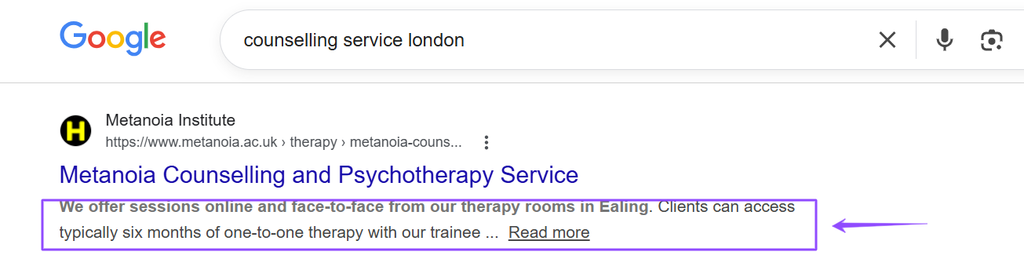
Meta descriptions sit underneath the title and give the click more context.
It doesn’t need to repeat the title in a slightly longer sentence.
It needs to support it.
That means a good meta description usually helps someone understand:
- What kind of page this is
- What they’ll get if they click
- Why it might be relevant to them
So while the title grabs attention, the description helps confirm whether the click feels worth it.
Meta Description Example:
What a Good Meta Description Should Do
| 1: It Reflects The Page honestly If the page is a service page, the description should sound like a service page. If it’s a blog post, it should sound like a blog post. In other words: say what’s actually there. “Be your reader” is a useful rule here — think about what someone expects to see after clicking, then follow through on that. |
| 2: It Gives a Reason to Click This is where a lot of meta descriptions fall flat. They describe the page, but they don’t make it feel useful.The click usually happens when the reader thinks this is relevant, it sounds like my problem, and this page probably has the answer. |
| 3: It Uses Keywords Naturally If the keyword fits, use it. But use it like a human would. The goal isn’t to force it in awkwardly. The goal is to reinforce relevance without making the copy sound robotic. |
| 4: It’s Specific Specificity does the heavy lifting here, just like it does on the page itself.Vague: Professional copywriting solutions for modern businesses.Better: SEO copywriting for service businesses that want clearer website messaging and better-fit leads. |
Examples of Metas for Therapist Websites
Not every page should sound the same.
Different pages are doing different jobs, so the metadata should reflect that.
Homepage
The title should make it clear what type of therapy or counselling you offer, and who you support.
The description should explain your approach, the people you work with, and what potential clients can expect from your services.
Example title: Counselling & Psychotherapy for Adults | Online Therapy
Example description: Compassionate counselling and psychotherapy for adults experiencing anxiety, stress and life challenges. Explore online therapy in a supportive space.
Service Page
The title should clearly name the type of therapy or counselling you offer.
The description should explain what the service helps with and give potential clients a reason to explore it further.
Example title: Anxiety Counselling | Support for Stress & Worry
Example description: Struggling with anxiety, persistent worry or overwhelming thoughts? Explore how anxiety counselling can help you understand your feelings and find support.
Local Service Page
The title should include your therapy or counselling service and the location you cover naturally.
The description should reinforce your location, explain the support available, and help potential clients decide whether your services are relevant.
Example title: Therapist in Manchester | Anxiety Counselling
Example description: Looking for anxiety counselling in Manchester? Explore a supportive, confidential space to talk through your experiences and learn how therapy works.
About Page
The title should make it clear that this is where potential clients can learn more about you and your practice.
The description should introduce your experience, therapeutic approach, and the people you support. Remember, choosing a therapist is a personal decision, so this page should help potential clients get a sense of who you are.
Example title: About Sarah | Qualified Counsellor & Psychotherapist
Example description: Meet Sarah, a qualified counsellor and psychotherapist. Learn about her therapeutic approach, experience and how she supports adults through life’s challenges.
Contact Page
The title should make it easy for potential clients to understand how to contact you or enquire about therapy.
The description should make the next step feel straightforward, whether that’s asking a question, booking an initial consultation, or finding out more about your services.
Example title: Contact Sarah | Counselling & Therapy Enquiries
Example description: Thinking about starting counselling? Get in touch with Sarah to ask a question, enquire about availability or arrange an initial consultation.
DOWNLOAD THE META TITLE & DESCRIPTION FORMULA CHEAT SHEET
AI Prompts for Meta Titles and Descriptions
Let’s face it, meta titles and descriptions are boring. So, if you dread writing them as much as I do, here are some prompts that work with ChatGPT, Claude, Gemini, and any other tools you use.
Meta Title Prompts
1: Write Meta Titles From Scratch
You’re an SEO copywriter writing meta titles for a service-based business website.I need you to write 12 meta title options for this page. Page type: [homepage / service page / local service page / about page / contact page] What the page is about: [insert short summary] Target audience: [insert audience] Primary keyword: [insert keyword] Location: [insert location if relevant] Business name: [insert name if relevant] What I need: 4 straightforward options4 more benefit-led options4 more specific options Rules: Keep each title clear, natural, and focused. Aim for around 50–60 characters. Use the keyword only if it fits naturally. Use British English. Avoid filler, generic wording, and robotic phrasing. Don’t make the titles sound over-polished or salesy. Then: Choose the top 3, explain which one is strongest, and give me one final recommended version. |
Prompt 2: Rewrite this title
Rewrite this meta title 10 different ways: [paste title] Page type: [insert] Page topic: [insert] Audience: [insert] Primary keyword: [insert] Location: [insert if relevant] Rules: Make the topic obvious, Keep it natural, Avoid sounding robotic or salesy. Aim for 50–60 characters Then: rank the best 3 and give one final recommended version |
Prompt 3: Write titles for multiple pages
| Write 3 meta title options for each of these pages. For each one: Keep it clear and natural Aim for 50–60 characters Use the keyword only if it fits naturally Avoid filler and generic wording Pages: Page type: [insert] Page topic: [insert] Audience: [insert] Primary keyword: [insert] Location: [insert if relevant] Choose the strongest title for each page and explain briefly why it works |
Meta Description Prompts
1: Write better meta descriptions
| You’re an SEO copywriter writing meta descriptions for a service-based business. I need you to write 12 meta description options for this page. Page type: [homepage / service page / blog post / location page] What the page is about: [insert short summary] Target audience: [insert audience] Primary keyword: [insert keyword] Location: [insert location if relevant] Main benefit of the page: [insert benefit]] What I want the reader to do next: [insert CTA] What I need:- 4 straightforward options- 4 pain-point-led options- 4 outcome-led options Rules:- Keep each option around 140–160 characters- Make the keyword feel natural Then:- choose the top 3- tell me which one is strongest- give me one final edited version that sounds the most natural |
Prompt 2: Refine My Meta Description
| You’re editing a meta description for a service-based business. Here is the current version: [paste meta description] Here is the page context: – Page type: [homepage / service page / blog post / location page] – What the page is about: [insert short summary] – Target audience: [insert audience] – Primary keyword: [insert keyword] – Location: [insert location if relevant] Rewrite this meta description 8 different ways. Tone of voice: – conversational – natural – sharp – specific – clear, not clever for the sake of it Use contractions like don’t, won’t, it’s. Avoid : – generic wording – filler – sounding salesy – sounding robotic – keyword stuffing – overpromising Make sure each option:- matches the page properly- sounds human- gives a reason to click- keeps the keyword natural Then:- rank the best 3- explain which one sounds the most clickable- give me one final recommended version |
Prompt 3: Batch Write Meta Descriptions
You’re an SEO copywriter writing meta descriptions for a service-based business website. I need you to write meta descriptions for the following pages. For each page: – write 3 options – keep them around 140–160 characters – make them sound natura l- include the keyword if it fits naturally – use British English – use contractions like don’t, won’t, it’s – avoid filler, generic wording, and robotic phrasing Pages: 1. Page type: [insert] Page topic: [insert] Target audience: [insert] Primary keyword: [insert] Location: [insert if relevant] Main benefit: [insert] 2. Page type: [insert] Page topic: [insert] Target audience: [insert] Primary keyword: [insert] Location: [insert if relevant] Main benefit: [insert] 3. Page type: [insert] Page topic: [insert] Target audience: [insert] Primary keyword: [insert] Location: [insert if relevant] Main benefit: [insert] After writing all options: – choose the strongest option for each page – explain briefly why it works – flag any that sound too vague or too AI-ish |
Small Changes Can Make a Big Difference to Your Website Visibility
Improving your therapy website’s visibility doesn’t always mean making huge changes or investing in expensive SEO services. Sometimes, it’s the smaller details that make a difference.
Your meta titles and descriptions are a good place to start. They help potential clients understand what you offer before they even visit your website, giving them a reason to click through and learn more.
Remember, the goal isn’t to impress Google with complicated keywords. It’s to make your services clear, relevant and easy to find for the people who need them.