
If you’ve spent five minutes researching marketing, you’ve hit this fork in the road: SEO or PPC?
Everyone has an opinion. Some swear paid ads are the only thing that moves the needle. Others will tell you SEO is the only strategy worth your time. Neither camp is being fully honest with you.
Here’s the truth: they do different jobs. One builds something that lasts. The other gets you seen right now. And for most independent businesses, the “right” answer depends less on which one is “better” and more on what stage you’re at and what you can actually commit to.
Let’s break both down properly, so you can make a decision that fits your business — not someone else’s sales pitch.
First, What Are We Actually Talking About?
SEO (Search Engine Optimisation) is the unpaid, organic route. You improve your website — the content on it, the trust signals pointing to it, and the technical bits under the hood — so Google chooses to rank it higher for the searches your ideal clients are actually typing in.
PPC (Pay-Per-Click) is the paid route. You bid for placement — on Google, Instagram, Facebook, wherever your audience hangs out — and you pay every time someone clicks through. Turn the budget off, and the visibility stops with it.
Neither is inherently better. They’re just built for different jobs.
SEO: The Slow Build That Compounds
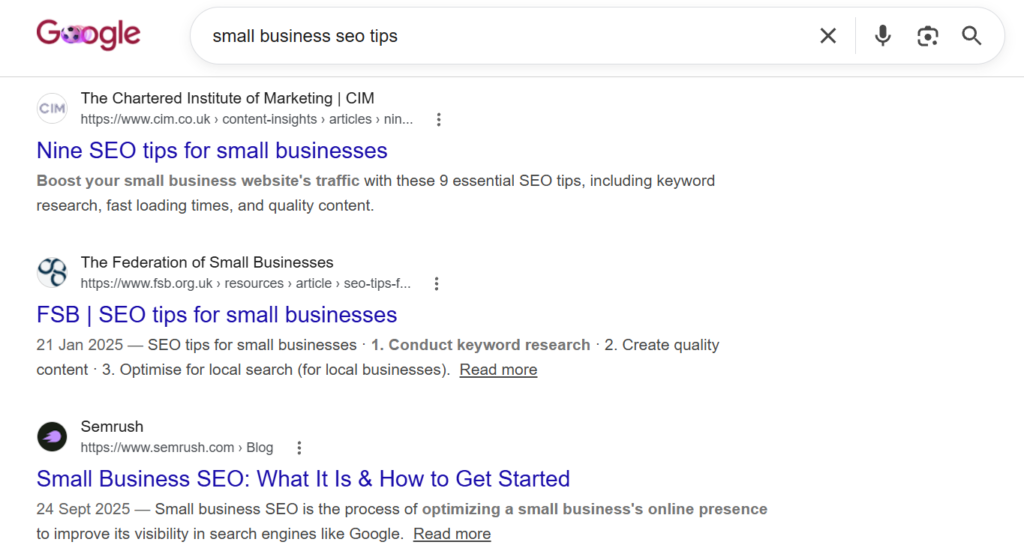
SEO isn’t one thing — it’s three working together:
- What people see: your page content, headings, and how your pages link to each other
- What builds your reputation: other credible websites linking back to you, which tells Google you’re worth trusting
- What happens behind the scenes: how fast your site loads, whether it works properly on a phone, and other technical health checks
Why it’s worth the effort
It keeps working after you stop. Once a page starts ranking, it can keep bringing in visitors month after month without you paying per click. That’s the whole appeal — you’re building an asset, not renting attention.
It gets cheaper over time, not more expensive. The investment is mostly your time and consistency rather than a media spend. Reported returns on SEO content vary hugely by source and industry, but the pattern holds: well-executed organic content tends to keep paying you back long after you’ve published it.
It snowballs. Every decent piece of content and every credible link adds to your site’s overall authority, which makes the next piece of content work a little harder too. Early effort makes later effort more effective.
People trust it more. Organic results still carry more credibility with most searchers than an ad slot does — there’s a well-documented “it earned its spot” effect that paid placements don’t get.
It can meet people at every stage. A blog post answers a question. A comparison page nudges someone weighing options. A well-optimised service page catches someone ready to buy. Done properly, SEO content can guide someone from “just looking” to “ready to enquire.”
Where it falls short
It’s genuinely slow. You’re not seeing results next week. Most small businesses start noticing traction after a few months, and in crowded niches, it can take longer still. If you need income this month, SEO alone won’t get you there.
Google moves the goalposts. Algorithm updates can shift rankings overnight, sometimes for reasons that have nothing to do with the quality of your work. Recovery takes time.
It never really finishes. Rankings you’ve earned need maintaining — fresh content, ongoing technical upkeep, continued relevance. Let it go stale and competitors will happily take your spot.
PPC: Visibility on Demand
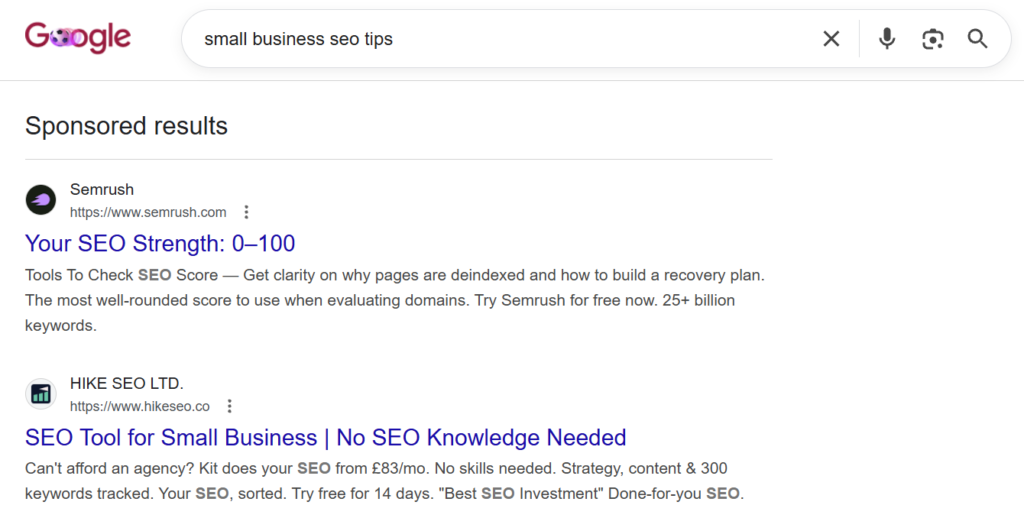
PPC covers a few different formats, and most small businesses will only ever need one or two:
- Search ads — appear above the organic results when someone searches your target keywords
- Display ads — banner-style ads shown across a network of partner websites based on browsing behaviour
- Shopping ads — product listings shown directly in search results, mostly for ecommerce
- Social ads — Meta, LinkedIn, TikTok, etc., targeted by demographic and interest rather than search intent
Why it’s worth the spend
You’re visible immediately. Launch a campaign today, get clicks today — assuming your targeting and bidding are set up properly. There’s no waiting around for Google to notice you exist.
You can be precise about who sees it. Location, interests, search behaviour, demographics — you can narrow your audience down to exactly the people most likely to want what you sell.
Everything is measurable. Every impression, click, and conversion is tracked, which makes it far easier to know what’s working and reallocate budget accordingly than with organic content.
You stay in control. Pause it, scale it, kill it — whenever you like. Your spend never runs away from you unnoticed if you’re keeping an eye on it.
Where it falls short
It costs real money, continuously. UK small businesses typically spend anywhere from a few hundred to several thousand pounds a month on paid ads, and that figure climbs fast in competitive industries. Bid too low, though, and your ads simply won’t show — so there’s a floor below which the spend stops being effective at all.
The tap only runs while it’s on. Stop paying, and your visibility disappears with it. Unlike SEO, there’s no lingering benefit once the campaign ends.
Some audiences are just wary of ads. In higher-trust sectors — think therapists, tradespeople, professional services — people often click past ads and gravitate toward organic results instead, because organic still reads as more credible.
It’s easy to get wrong. Targeting, bidding strategy, negative keywords, ongoing optimisation — there’s a real learning curve, and a badly managed account can burn through budget with little to show for it.
SEO vs PPC: Which One Should You Actually Choose?
Neither has to win outright — and for most independent businesses, the smartest move is using them for different jobs at different times.
Use PPC when you need visibility now: launching, testing a new offer, covering a seasonal gap, or simply needing income before your organic presence has had time to build. Use SEO to build the foundation that keeps paying you back long after any single campaign ends.
A common, sensible approach: run paid ads to generate leads while your SEO work is still finding its feet in the background. Once your organic rankings start pulling their weight, you can ease off the ad spend — or keep both running for maximum visibility, if budget allows.
What matters most is being honest about your budget, your timeline, and what you’re actually trying to achieve. That’s the difference between businesses that see steady, compounding growth and those that burn cash chasing quick wins that vanish the moment the campaign stops.
If you’re not sure where to start, that’s exactly the kind of conversation worth having before you spend a penny — get in touch and we’ll figure out what actually makes sense for where your business is right now.
FAQs
Is SEO still worth it in 2026?
Yes — but it’s evolving. With AI-powered search results and AI overviews becoming more common, SEO now also means making sure your content is structured clearly enough to be picked up and cited by AI tools, not just ranked in a traditional list of blue links.
Is PPC harder to manage than SEO?
They’re difficult in different ways. PPC demands close budget and bid management to avoid wasted spend. SEO demands patience and a solid long-term content strategy. Neither is “easy” — they just ask different things of you.
Should I outsource this or handle it myself?
Depends entirely on your time, confidence, and team. If you’re already stretched thin running your business, outsourcing the area you’re weakest in — whether that’s the strategy side or the execution — usually pays for itself. If you’ve got the bandwidth and the interest, there’s nothing stopping you from learning the basics yourself.