
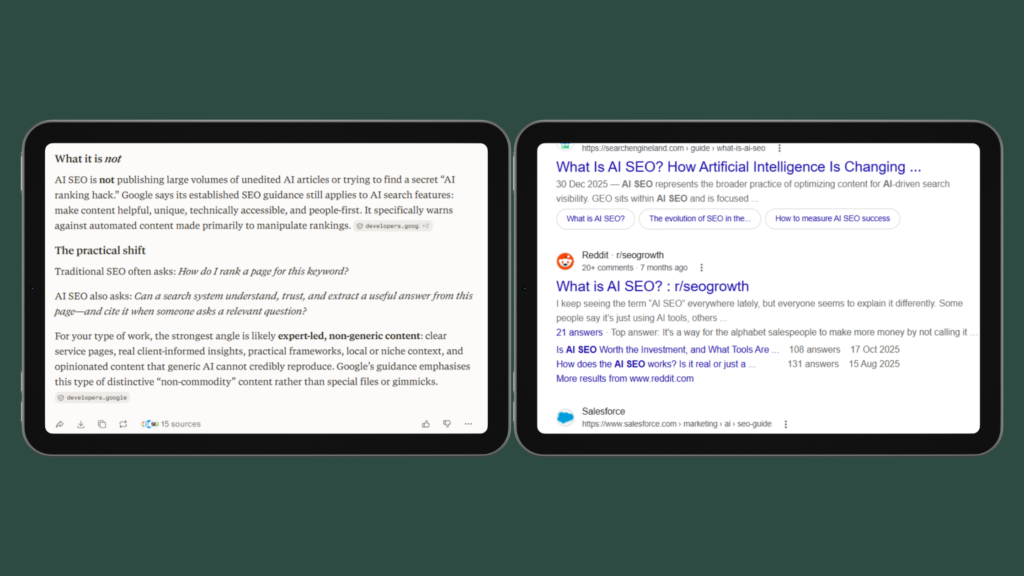
SEO is changing. I’ll say that again: changing. It’s not going away or no longer relevant (despite what you might see on social media). But the rise of artificial intelligence means that standard search engine optimization is no longer enough.
AI SEO is becoming a must-have for businesses of all sizes. In 2026, 37% of people use AI for online searches instead of turning to Google, underscoring the importance of ensuring your website appears in these searches (Search Engine Land).
But if you’re new to optimizing for AI, it can feel like you’re entering uncharted territory. So, in this post I’ll cover everything you need to know as a beginner, including:
- What AI SEO actually is and why it’s important
- How optimising for AI searches is different to traditional SEO
- Why traditional SEO techniques are still essential
- And how to ensure that your website appears in AI citations
TL;DR: AI SEO For Beginners
The shift: More people are searching via AI tools (ChatGPT, Perplexity) instead of Google, and even Google searches now often end with AI Overviews rather than a click-through. This means businesses need to optimise for AI citations, not just search rankings.
Traditional SEO vs. AI SEO:
- Goal: Ranking pages → Getting picked as source material
- Unit of content: Whole pages → Small, extractable chunks
- Success metric: Click-throughs → Mentions and citations
- What matters: Keywords, backlinks, speed → Clarity, structure, trustworthiness
How to write content AI tools will cite:
- Answer fast — lead with the answer, don’t build up to it
- Target real questions — use tools like AlsoAsked or AnswerThePublic to find what people actually ask, and use those as subheadings
- Write clearly — short, self-contained paragraphs; bullets and tables over walls of text; explain jargon
- Add FAQ sections covering common customer questions
- Build credibility — depth and originality matter more than volume, in line with Google’s E-E-A-T principles
Bottom line: AI SEO doesn’t replace traditional SEO — both work together, and it’s an ongoing practice, not a one-off task. Quality, trustworthy content that genuinely serves your audience remains more important than any optimisation tactic.
If you’d like to make sure your website appears consistently across all channels, my content strategy services and ongoing consulting give you everything you need for ongoing growth.
Not ready for support? Download my Free Get Found Playbook.
What is AI SEO?
AI SEO – also known as LLM optimisation, generative engine optimisation (GEO), or AI visibility) is a process that involves optimising your website so it appears in AI search results when users ask a question.
For example, let’s say we type this into Perplexity: “Which software is best for project management?” The following results come up:
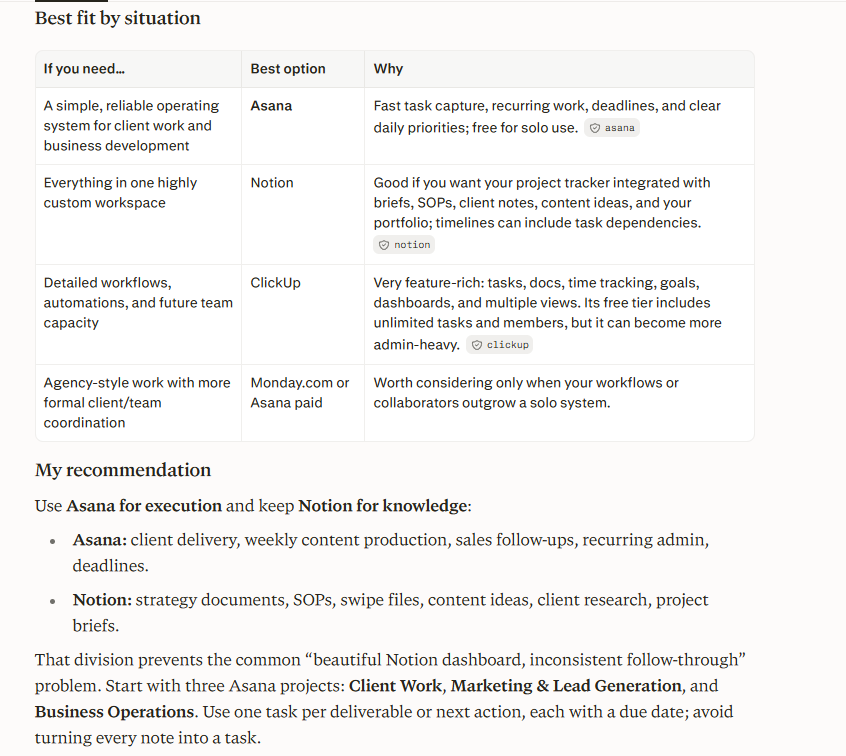
As you can see, these results work differently to a traditional search engine like Google:
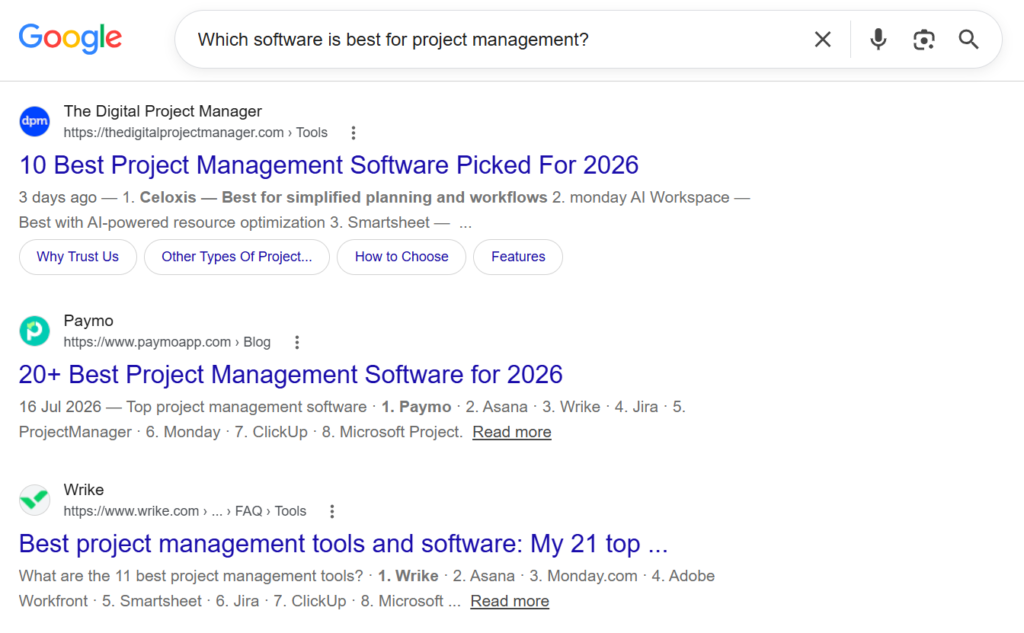
So, while Google and Bing bring up relevant website pages and blog posts based on the intent behind your search, AI tools cite sources.
This is important because it changes how we approach optimization.
How Do AI Models Work?
When AI models are asked a question, they scan relevant sources and cite suitable sources when creating answers. So, it’s less about getting your page to rank, and more about ensuring that your content is structured well, easy to extract, and reliable enough to source.
We’ve covered traditional LLMs like ChatGPT and Perplexity, but Google also has an AI Overviews feature that appears on the main search results page.
Again, if we use the project management software example, you can see the AIO appearing before the organic search results:
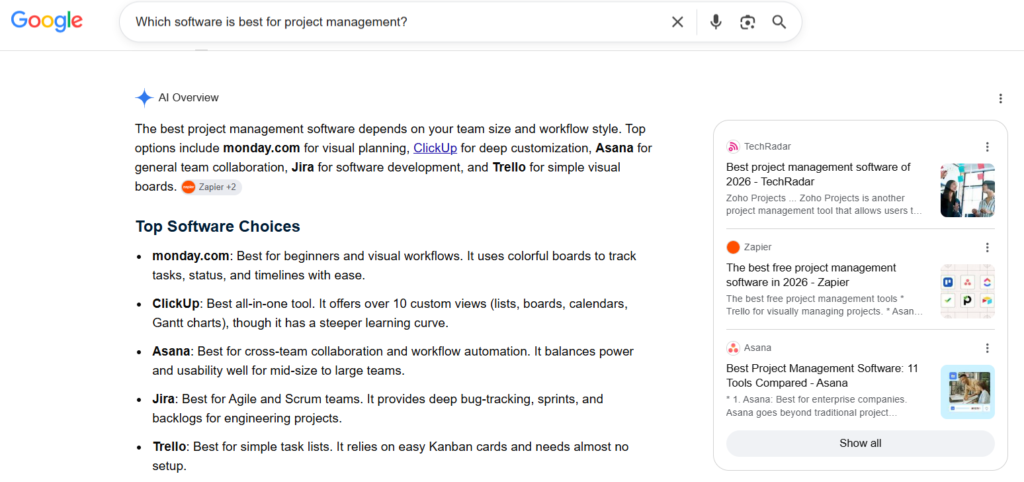
Notice how there are links to sources in both the content and the right side? These are massively important, and I’ll cover why later.
practice of shaping your website’s content so that AI tools can find it, understand it, and use it when they answer someone’s question.
Why are LLM and GEO Important?
Optimising for AI models is essential for a range of reasons, including changing customer behaviours, the need for citations, and the need to become a trustworthy source of information.
Changing Search Behaviours
As we covered before, more people are performing AI searches today. However, it’s also important to remember that even traditional Google searches have changed, thanks to AI Overviews.
One study by SparkToro revealed that 68% of searches in early 2026 were no-click, with AI Overviews providing answers to questions.
Building Trust
Just as securing first page rankings on Google establishes your website as trustworthy and credible, so does being cited by AI.
These models have loads of websites to compare and cite, so when people see your content as a result, they’re more likely to view you as an industry authority.
You Avoid Falling Behind
It’s easy to get caught up in not wanting things to change. You’ve probably spent time getting to grips with traditional SEO and local SEO, only to find that AI is another burden. But not optimising for AI is a surefire way to halt your website’s growth.
Staying on track with traditional SEO, while also factoring in AI optimization means you can keep up with (or sometimes stay ahead of) the competition.
AIO vs SEO: How Do They Differ?
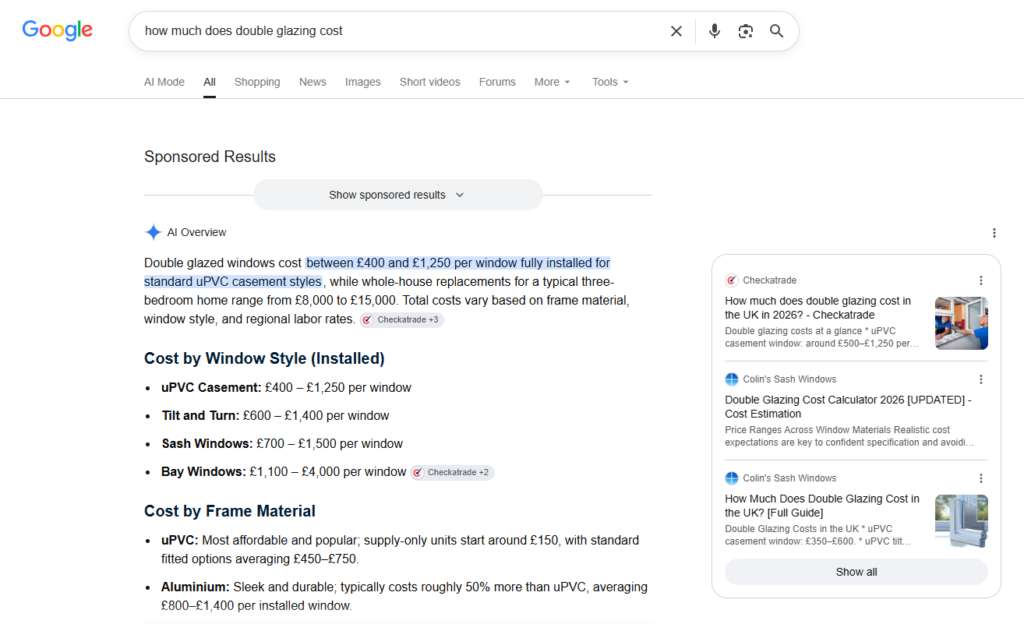
I’m not about complex explanations, and you probably don’t have time for them, so let’s keep this simple. Imagine two customers are asking the same question: “How much does double glazing cost?”
The Google Version
On Google, they’ll get these answers, which feature different web pages and AI Overviews. Visitors can either click on the links to read the full posts or read the AIO.

AI Tools
AI tools include a short, direct paragraph explaining the average costs of double glazing, based on information from other websites.

While some people who are actively looking for double glazing solutions might click through to those sites, others may just want information, but remember the websites that were cited later on.
| Traditional SEO | AI SEO | |
| Goal | Rank near the top of results | Get picked as source material for the answer |
| The Unit AI/Google Works With | Whole pages | Small, extractable chunks of text |
| What Defines Success | A click through to your website | Mentions, recommendations, and citations |
| Rewards | Keywords, backlinks, technical speed | Clarity, direct answers, structure, trustworthiness |
It’s not about choosing one method over the other, as both play a core part in getting your website to appear online and attract visitors.
How to Write Content For AI Citations
It’s common to feel like you’re in a never-ending battle between trying to write quality content for your audience while also factoring in writing for search engines and AI tools.
One thing I will say here is that quality content is much more important than appearing on the SERPs and AI engines.
But knowing how to succeed with both gives your website more visibility and converts clicks into customers.
Here’s how to create content to increase the chances of securing AI citations:
Quick Answers
Don’t waffle or try to set the scene. If you’re writing a blog post about the costs of pet sitting services, answer it immediately. This can be done by answering in the first sentence or using an overview, as it’s easier for AI models to extract information.
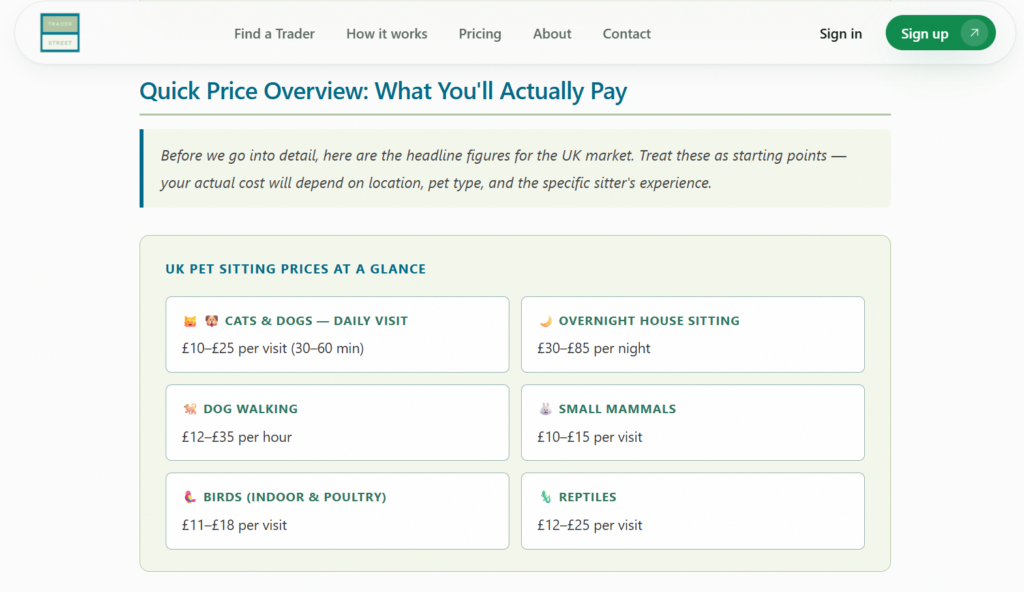
For example, as you can see from this AI Overview, Google uses Trader Street as its main reference, and this is why:
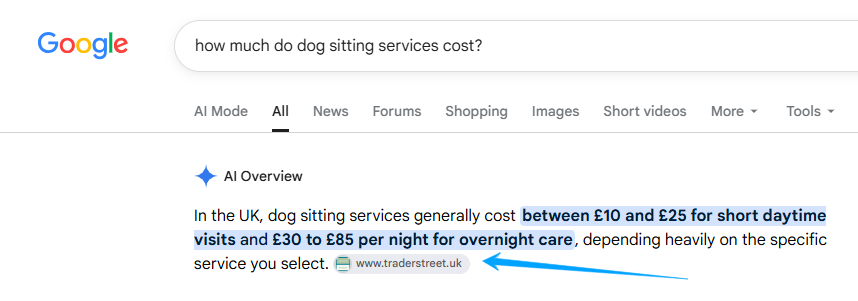
The post answers the question immediately without making people wait, which also means AI models can extract pricing.
Use Questions People Ask
This is one of the most valuable techniques you can use. Head to a tool like AlsoAsked or Answer the Public, and type in your main keyword. For example, I used AI Optimization, and AlsoAsked brought up these results:
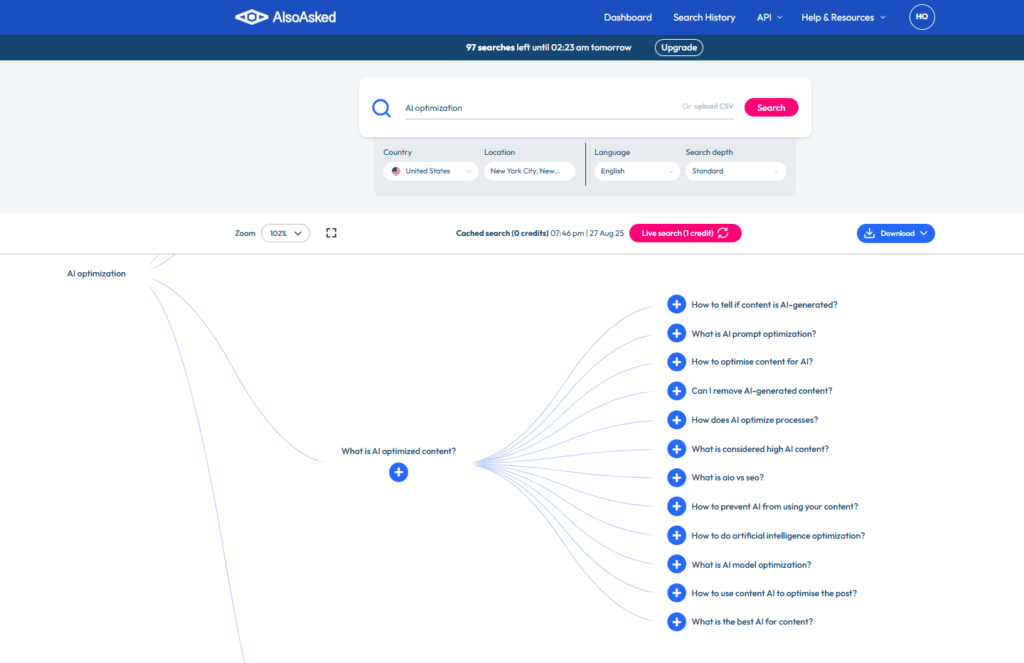
These are questions that people are actually asking, so when you make them subheadings and answer directly, it improves your chances of being cited by AI.
Write Clearly
Each section should stand on its own, stay easy to scan, and be written in plain language.
Break content into short paragraphs, bullet points for lists, numbered steps for sequences, and tables for comparisons, since a wall of text is hard for both readers and AI systems to extract value from.
And skip jargon that only makes sense to insiders — it just makes your content harder to match to a plain-English question, so if you must use a technical term, explain it right there.
Use FAQ Sections
Create dedicated FAQ sections that focus on the questions people actually ask. You can find these questions by using tools like AlsoAsked or AnswerThePublic and by checking your emails and call logs.
Credibility is Key
The formatting might be great, but it will only get you so far. AI tools are similar to how search engines work, because they’re trying to find out whether you’re a trustworthy source of information.
This means writing FOR your audience, and prioritising depth over volume. Both AI and SEO writing can only work when you align with Google’s E-E-A-T principles and cover topics in depth.
Generic content that lacks originality is a fast way to make your website unattractive to AI engines.
Final Thoughts
AI SEO will continue to be a core factor in your brand’s visibility and ability to convert visitors into customers. It’s not about choosing between traditional SEO and AI optimisation, as both are vital for long-term website growth.
However, content quality, depth, and genuinely useful information for your audience will always be more important than optimisation.
Need support with your AI content strategy? My one-off and ongoing consulting services give you some much-needed direction.
FAQs
Do I need to abandon my normal SEO strategy to focus on AI search?
Absolutely not! Traditional SEO is still the foundation for ongoing website visibility and growth, and a website that ranks high while also providing a seamless user experience is more likely to appear in AI searches.
Is AIO easier than SEO?
Neither is inherently easier, but AI tools prioritise well-written content fragments rather than a website’s overall authority. So, you may have higher chances of appearing in these results.
How do I know if my GEO strategy is working?
Ask the AI tools yourself. Search a handful of questions your customers would realistically ask in ChatGPT, Google’s AI Overviews, and Perplexity, and see whether your business comes up. It’s rough and manual, but it’s a genuinely useful starting point before investing in more formal tracking.
Is AI SEO a one-off project or an ongoing job?
Ongoing, the same as SEO always has been. AI tools update what they know over time, competitors are doing the same work, and your own business changes. Treat it as a habit you build into your content writing, not a task you tick off once.