
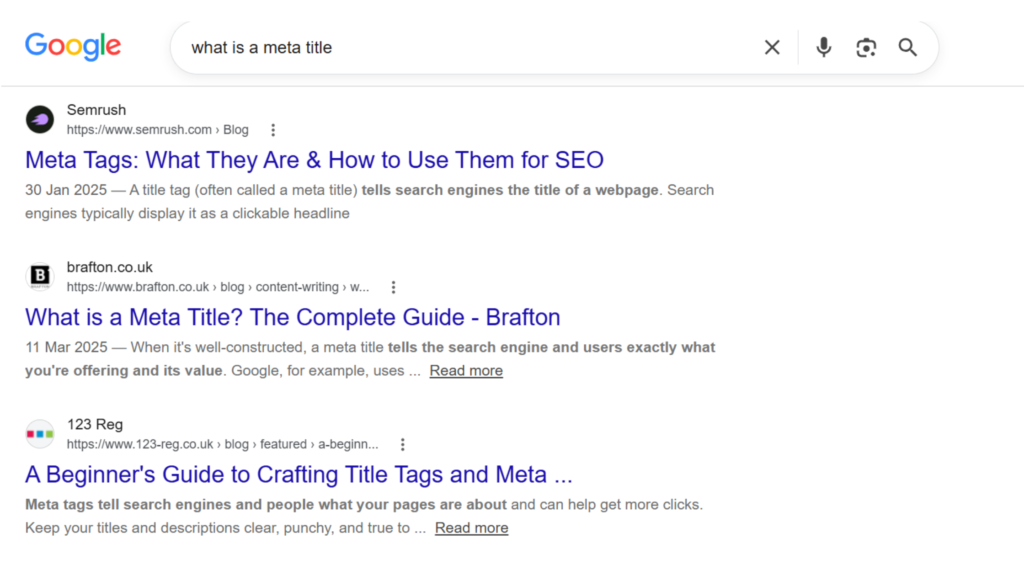
Your meta title and meta description are often the first version of your message someone sees, before they ever land on your site. They won’t do all the heavy lifting, but they shape the first impression and help someone decide:
Is this relevant?
Is this what I’m looking for?
Is this worth clicking?
Generic metadata wastes that opportunity. If the page itself is specific but the search result is vague, you’re making the reader work too hard before they’ve even clicked through. Good metadata should make the page easier to understand, not harder.
In this post I’ll cover how to write meta descriptions and titles that get clicks and send people through to your website.
What Are Meta Titles?
Meta titles are also known as title tags. They appear on the search engine results page as a blue link, and describe what the page is about.
As you can see from this image, the meta title is the first thing people see when they use a search engine:
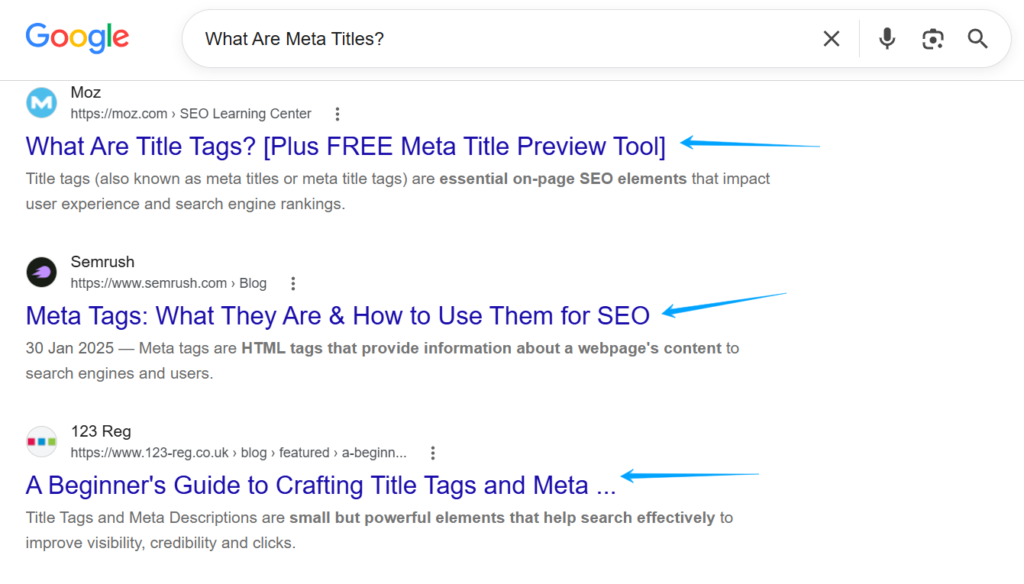
Because of this, the meta title should be clear, easy to read, and compelling. Basically, think of it as the headline.
The four things a good meta title does
Meta titles do four things well. They make the page topic obvious, are relevant, stay focused, and sound natural.
Making the page topic obvious
People should be able to immediately see what your page is about, with no guesswork. For example, if you’re writing a meta title for a blog post, it should make the post’s topic and content clear immediately.
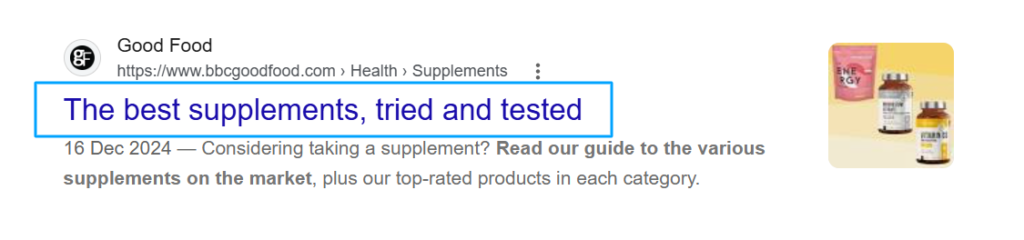
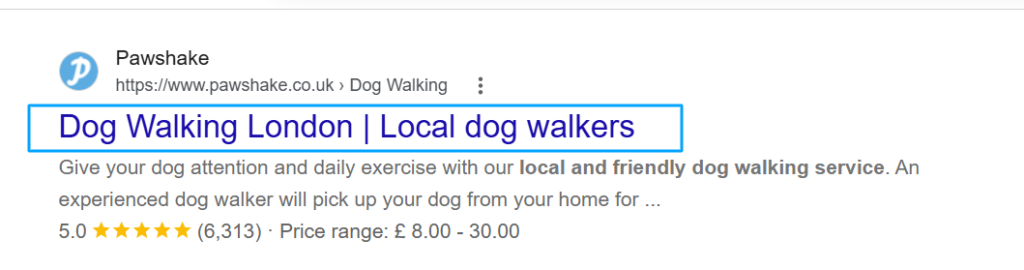
But if you’re creating meta titles for a homepage, the core service and business type should be clear.
It’s relevant
Never make promises you can’t keep. While doing something creative to get clicks, like promising “5 Tips that Will Make You Rich Overnight” might seem like a great idea, it’s only going to lead to disappointment if your post is about side hustles.
You’re not overselling; you’re making a promise to your audience.
There’s a clear focus
Meta titles usually work best when there’s a clear focal point rather than different phrases. For example, you shouldn’t list every service you offer – even in the homepage meta title. You should also avoid mentioning every location.
It’s natural
There was a time when writing meta titles was about cramming as many keywords as possible. Today, it’s about sounding natural. Clarity is better than fitting in multiple keywords, as it gives you a better chance of clicks.
What Are Meta Descriptions?
Meta descriptions are the text that sits under your meta title. Their job is to add context to the title, not just repeat it. Think of it like this:
Meta Titles = The Header
Meta Descriptions = Subheaders
The four things a good meta description does
Writing meta descriptions is about focusing on four different principles, so that readers can understand what kind of page they’re clicking on, what they’ll get if they click, and why it’s relevant to them.
Every meta description should match these:
It reflects your page
If the page is a service page, the description should read like a service page description. If it’s a blog post, you should focus on introducing the article.
I always like to think of meta descriptions in terms of how audiences might view them. Would the content make them want to click through?
People have a reason to click
Speaking of giving people a reason to click, some meta descriptions just don’t cut it. They describe the content, but there’s no reason for someone to want to learn more. Take a look at these, and you’ll see what I mean.
This is a generic meta description that doesn’t really give anyone a reason to click. In fact, it just summarises the post:
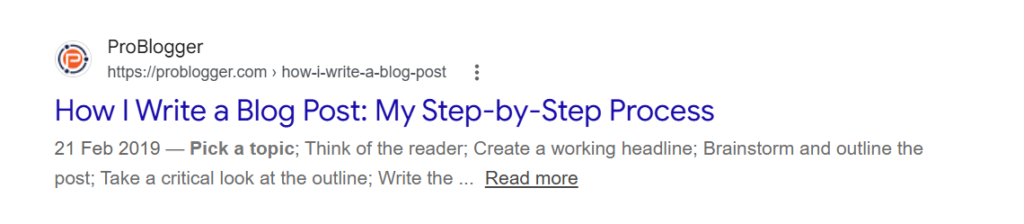
This is a great meta description that does give people a reason to click:

See the difference?
The keywords are natural
If the main keyword you’re targeting fits the meta description, then use it. But make sure you insert the term naturally and avoid stuffing it just to fit the keyword in. People notice this, and it won’t do your content any favours.
It’s specific
Specificity is doing most of the persuasive work here, in exactly the same way it does on the page itself. Compare:
- Vague: “Professional copywriting solutions for modern businesses.”
- Better: “SEO copywriting for service businesses that want clearer website messaging and better-fit leads.”
The vague version could describe almost any copywriter’s website. The specific version names the audience (service businesses), the problem (unclear messaging), and the outcome (better-fit leads).
Writing Meta Titles and Descriptions for Different Page Types
Not every page on a website is doing the same job, so its metadata shouldn’t sound identical either. A homepage is introducing the whole business; a service page is selling one specific thing; a contact page just needs to make the next step obvious.
Here’s how that distinction plays out in practice:
Homepage
The title should make the service area or business type clear at a glance, since this is often someone’s very first touchpoint with the brand. The description should cover what you do, who it’s for, and what kind of result or direction the site offers overall.
Title: Brand Designer for Small Businesses
Description: Brand design for small businesses that want a clearer identity, stronger visuals, and a brand that feels more consistent.
Learn More About Homepage Copywriting Tips.
Service page
The title should name the specific service clearly and unambiguously. The description should explain what the service actually helps with, and give a concrete reason to click through rather than move on to a competitor’s result.
Title: Website Copywriting Services for Service Businesses
Description: Need clearer website copy? Get strategic messaging that helps your service pages make sense and turn more visitors into enquiries.
Learn More About Service Page Copywriting.
Local service page
The title should weave in both the service and the location naturally, since these pages are usually targeting “[service] in [place]” searches. The description should support that local focus without sounding like it was bolted on as an afterthought.
Title: Therapist in Manchester | Anxiety Support
Description: Looking for anxiety therapy in Manchester? Explore the support available, how it works, and what to expect before you book.
About page
The title should make it immediately obvious this is the about page, so people scanning results know exactly what they’re getting. The description should help someone understand who you are, who you typically work with, and how your process works.
Title: About Our Studio | Brand Design for Small Businesses
Description: Learn more about our approach to brand design, who we work with, and how we help small businesses build stronger, clearer brands.
Contact page
The title should make the intended next step unmistakable. The description should make getting in touch feel low-effort and clearly relevant, removing any hesitation about whether reaching out is appropriate.
Title: Contact Our Studio
Description: Get in touch to ask a question, enquire about support, or find out whether we’re the right fit for your project.
Using AI to Write Meta Descriptions and Titles (Without Sounding Like AI Wrote Them)
Meta titles and descriptions are, frankly, one of the more tedious parts of running a website — small, repetitive, easy to deprioritise.
That makes them a genuinely good use case for AI tools like Claude, ChatGPT, or Gemini, provided you give them enough context to avoid generic output.
Below are six prompts — three for titles, three for descriptions — covering the three situations you’re most likely to hit: writing from scratch, refining something that already exists, and batch-producing metadata across several pages at once.
The pattern in each prompt is the same and worth noticing, because it’s what makes AI-generated metadata actually usable rather than something you have to heavily rewrite.
Give the model real context about the page (type, topic, audience, keyword, location).
Give it explicit constraints (character counts, tone, language),
Specify things to avoid (filler, robotic phrasing, keyword stuffing), and then ask it to narrow its own output down to a single recommendation rather than leaving you to sift through twelve options yourself.
1: Write Meta Titles From Scratch
You’re an SEO copywriter writing meta titles for a service-based business website.
I need you to write 12 meta title options for this page.

Page type: [homepage / service page / local service page / about page / contact page]
What the page is about: [insert short summary]
Target audience: [insert audience]
Primary keyword: [insert keyword]
Location: [insert location if relevant]
Business name: [insert name if relevant]

What I need:

4 straightforward options
4 more benefit-led options
4 more specific options

Rules:

Keep each title clear, natural, and focused
Aim for around 50–60 characters
Use the keyword only if it fits naturally
Use British English
Avoid filler, generic wording, and robotic phrasing
Don’t make the titles sound over-polished or salesy

Then:
choose the top 3
explain which one is strongest
give me one final recommended version
Prompt 2: Rewrite this title
Rewrite this meta title 10 different ways:
[paste title]
Page context:
Page type: [insert]
Page topic: [insert]
Audience: [insert]
Primary keyword: [insert]
Location: [insert if relevant]
Rules:
Make the topic obvious
Keep it natural
Avoid sounding robotic or salesy
Aim for 50–60 characters
Then:
rank the best 3
give one final recommended version
Prompt 3: Batch Write Meta Descriptions
You’re an SEO copywriter writing meta descriptions for a service-based business website.
I need you to write meta descriptions for the following pages.
For each page:
– write 3 options
– keep them around 140–160 characters
– make them sound natural
– include the keyword if it fits naturally
– use British English
– use contractions like don’t, won’t, it’s
– avoid filler, generic wording, and robotic phrasing
Pages:
1. Page type: [insert]
Page topic: [insert]
Target audience: [insert]
Primary keyword: [insert]
Location: [insert if relevant]
Main benefit: [insert]
2. Page type: [insert]
Page topic: [insert]
Target audience: [insert]
Primary keyword: [insert]
Location: [insert if relevant]
Main benefit: [insert]
3. Page type: [insert]
Page topic: [insert]
Target audience: [insert]
Primary keyword: [insert]
Location: [insert if relevant]
Main benefit: [insert]
After writing all options:
– choose the strongest option for each page
– explain briefly why it works
– flag any that sound too vague or too AI-ish
The Bottom on How to Write a Meta Description and Meta Titles That Get Clicks
Meta titles and descriptions aren’t an exciting part of website copywriting, but they’re a core player in your brand’s ability to rank. So, here are the most important things to remember when creating metas;
- Write metadata per page, not as a template. A homepage, a service page, and a contact page are doing different jobs — their titles and descriptions should sound like it.
- Match the promise to the page. If the metadata oversells what’s actually there, you win the click but lose the visitor seconds later.
- Say it like a person would search it, not like a machine would parse it. Natural language reads better to humans and tends to perform just as well, if not better, for search engines.
- Revisit metadata periodically, especially on pages that get real traffic but low click-through — it’s often one of the cheapest, fastest things to test and improve.
Remember, if you choose to use AI prompts, to humanise the text and ensure your content or website copy performs. Need some support? Access my affordable SEO consulting services today.